

Japan
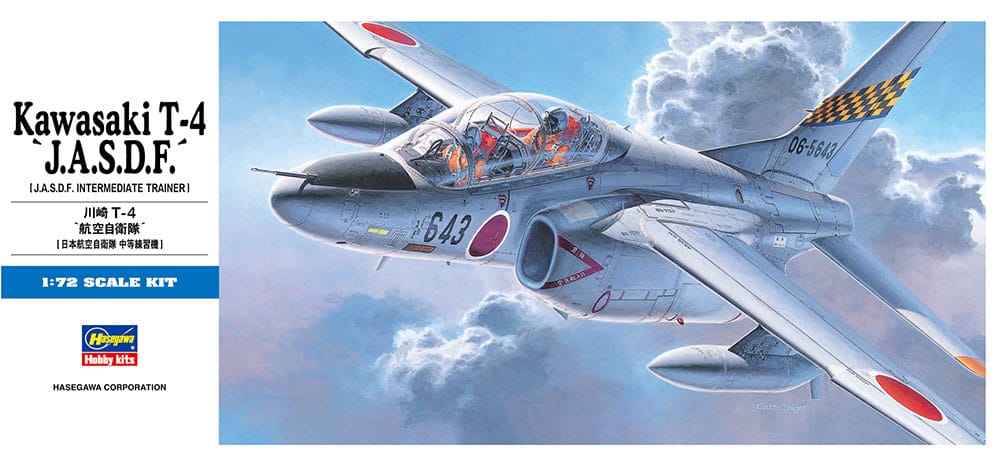
Kawasaki T-4
| type |
|---|
|
Plastic model kit |

This boxed set contains:
- 1 x Kawasaki T-4 1/72 scale trainer aircraft [D Series]

Japanese Air Self-Defense Force
The Kawasaki T-4 is a twin-engined jet training aircraft of the Japan Air Self-Defense Force.
The Air Self-Defense Force is aging T-33A and
I was forced to choose a new trainer that would change to a T1.
In the 56th year of the Showa era, the budget for the new training machine was approved
The MTX (new intermediate jet training aircraft) has been started.
The MTX, which was to be developed with a purely domestic machine,
It competed with three aircraft manufacturers, including Kawasaki Heavy Industries, Mitsubishi Heavy Industries, and Fuji Heavy Industries.
Kawasaki Heavy Industries became the main contract company in September 1958.
The aircraft was changed from MTX to X-T4 in October.
The basic design was started with the addition of design members of Mitsubishi, Fuji, Shin-Meiwa, and Nihon Aircraft.
The basic structure of the aircraft is equipped with a twin-engined engine, medium wing arrangement,
It was decided by tandem (vertical arrangement) cockpit arrangement.
A major change from the initial design was a change in the main leg device.
Initially, it was planned to arrange the main leg in the T2 format, but it has been changed to the F-104 format.
The engine was also considered foreign-made.
Finally, it was decided to the XF-3 engine made by Ishikawajima Harima Heavy Industries, which is domestic,
Both aircraft and engines were born in Japan.
This engine is a small turbofan engine with the latest technology with thrust power of 1.6tons,
The athletic performance of the aircraft by this engine is comparable to that of the F-15s.
In addition, many new technologies were developed in the XT4.
Using a lot of composite materials for the structural members of the aircraft,
OBOGS (On-Board Oxygen Generating System)
Adoption of digital data bus, adoption of AHRS with ring laser gyro,
In the Japan Air Self-Defense Force, it is the first escape device of the pea crushing method of the cai.
The first XT-4 was rolled out at Kawasaki Heavy Industries' Gifu Plant on April 17th.
He made his first flight on July 29th of the same year.
After that, after using four XT-4s and conducted various flight tests,
It was delivered to the Defense Agency.
The mass-produced aircraft of the T-4 was deployed to the first air wing in Hamamatsu in the 1960s and was replaced with the T-33A.
After that, the replacement with the T-33A for communication of each airline group also progressed sequentially,
The next stage of the T-1A/B has begun at the Ashiya base 13 cult.
As a result, the Air Force pilot,
From T-3 of the primary training machine reciprocating engine to the T-4 of the jet trainer,
It will be transformed into a rational training course for the F-15DJ and F-2B.
(Information at the time of the kit release)
[Data]
Crew: Two people.
Total width: 9.9m
Total length: 13.0m (including pito tube), 12.0m (not including pito tube)
Height: 4.6m
Engine: Ishikawajima Harima Heavy Industries F3-IHI-30
Thrust: 1,600kg x2
Standard take-off weight: 5,530kg
Maximum speed: Mach0.9 (advance 10,000m)
First flight (XT-4 1): July 29, 1968
This boxed set contains:
-
1*Kawasaki T-4 1/72 scale trainer aircraft [D Series]
The Kawasaki T-4 is a twin-engined jet training aircraft of the Japan Air Self-Defense Force.
The Air Self-Defense Force is aging T-33A and
I was forced to choose a new trainer that would change to a T1.
In the 56th year of the Showa era, the budget for the new training machine was approved
The MTX (new intermediate jet training aircraft) has been started.
The MTX, which was to be developed with a purely domestic machine,
It competed with three aircraft manufacturers, including Kawasaki Heavy Industries, Mitsubishi Heavy Industries, and Fuji Heavy Industries.
Kawasaki Heavy Industries became the main contract company in September 1958.
The aircraft was changed from MTX to X-T4 in October.
The basic design was started with the addition of design members of Mitsubishi, Fuji, Shin-Meiwa, and Nihon Aircraft.
The basic structure of the aircraft is equipped with a twin-engined engine, medium wing arrangement,
It was decided by tandem (vertical arrangement) cockpit arrangement.
A major change from the initial design was a change in the main leg device.
Initially, it was planned to arrange the main leg in the T2 format, but it has been changed to the F-104 format.
The engine was also considered foreign-made.
Finally, it was decided to the XF-3 engine made by Ishikawajima Harima Heavy Industries, which is domestic,
Both aircraft and engines were born in Japan.
This engine is a small turbofan engine with the latest technology with thrust power of 1.6tons,
The athletic performance of the aircraft by this engine is comparable to that of the F-15s.
In addition, many new technologies were developed in the XT4.
Using a lot of composite materials for the structural members of the aircraft,
OBOGS (On-Board Oxygen Generating System)
Adoption of digital data bus, adoption of AHRS with ring laser gyro,
In the Japan Air Self-Defense Force, it is the first escape device of the pea crushing method of the cai.
The first XT-4 was rolled out at Kawasaki Heavy Industries' Gifu Plant on April 17th.
He made his first flight on July 29th of the same year.
After that, after using four XT-4s and conducted various flight tests,
It was delivered to the Defense Agency.
The mass-produced aircraft of the T-4 was deployed to the first air wing in Hamamatsu in the 1960s and was replaced with the T-33A.
After that, the replacement with the T-33A for communication of each airline group also progressed sequentially,
The next stage of the T-1A/B has begun at the Ashiya base 13 cult.
As a result, the Air Force pilot,
From T-3 of the primary training machine reciprocating engine to the T-4 of the jet trainer,
It will be transformed into a rational training course for the F-15DJ and F-2B.
(Information at the time of the kit release)
[Data]
Crew: Two people.
Total width: 9.9m
Total length: 13.0m (including pito tube), 12.0m (not including pito tube)
Height: 4.6m
Engine: Ishikawajima Harima Heavy Industries F3-IHI-30
Thrust: 1,600kg x2
Standard take-off weight: 5,530kg
Maximum speed: Mach0.9 (advance 10,000m)
First flight (XT-4 1): July 29, 1968