

United States
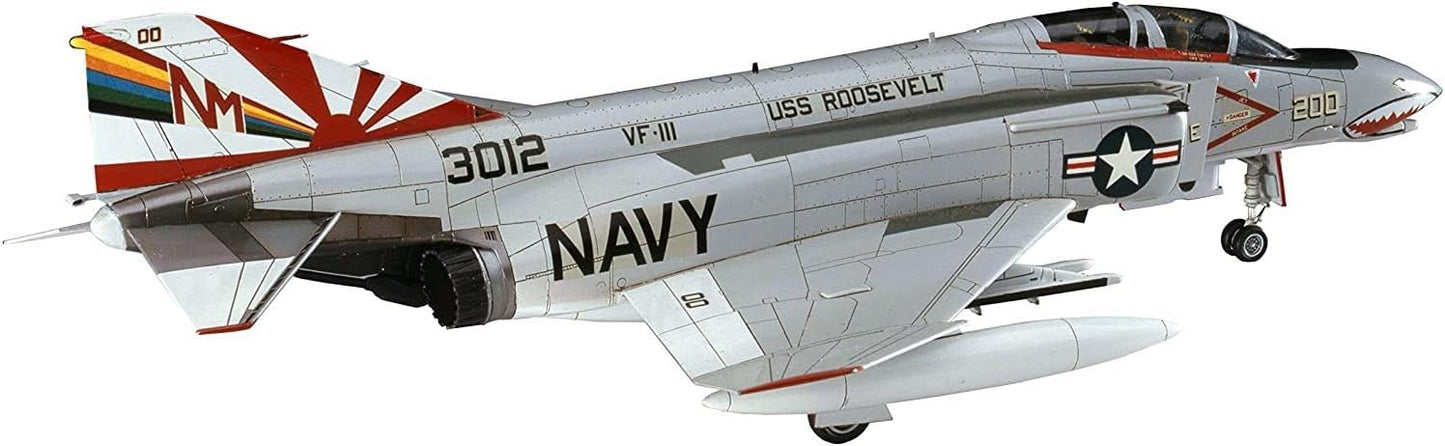
McDonnell Douglas F-4B/N Phantom II
| type |
|---|
|
Plastic model kit |

This boxed set contains:
- 1 x McDonnell Douglas F-4B/N Phantom II 1/72 scale multirole fighter aircraft [E Series]

United States Marine Corps Aviation
United States Navy

The F-4 Phantom II has over five thousand aircraft in total production.
It became a bestseller of the liberal camp's supersonic fighter.
With excellent all-weather fighting ability,
The U.S. Navy is versatile in both air warfare and ground attacks.
It is a factor that has been adopted by the Marine Corps, the Air Force, and other foreign countries and is still active today.
It was originally developed as an all-weather fighter of the United States Navy.
The first prototype was first flown on May 27, 1958.
In the Navy, the first mass-produced type B type, the N type that improved the B type,
We developed the developmental type into the S type that improved the J type and the J type, which became the main force.
The Air Force also decided to adopt it as a C type, and it was an improved C type D,
Long nose type E type equipped with Vulcan cannon on the nose,
There is a wild-weasel G-type,
Derivatives include the Marine Corps reconnaissance RF-4B and the Air Force RF-4C.
In addition, the Air Self-Defense Force also produced the aircraft of the E type of the Air Force as EJ type,
The reconnaissance type uses the RF-4E.
F-4J Crew: Two people
Total width: 11.71m
Total length: 17.76m
Height: 4.96m
Maximum take-off weight: 24,770kg
Engine: General Electric J79-GE-10×2
Thrust: 5,377 (8,120kg when using afterburna) x 2
Max speed: Mach2.2/12,200m
Fixed armament: None
First flight: 1966.5.27
Decal (marking)
F-4N: U.S. Navy VF-111 “Sundowners” CAG aircraft “NM200”
F-4B: U.S. Navy VF-151 ‘Vigilances‘ CAG aircraft ‘NF200‘
・F-4B: U.S. Marine Corps VMFA-115 “Silver Eagles” aircraft “VE10”
This boxed set contains:
-
1*McDonnell Douglas F-4B/N Phantom II 1/72 scale multirole fighter aircraft [E Series]
The F-4 Phantom II has over five thousand aircraft in total production.
It became a bestseller of the liberal camp's supersonic fighter.
With excellent all-weather fighting ability,
The U.S. Navy is versatile in both air warfare and ground attacks.
It is a factor that has been adopted by the Marine Corps, the Air Force, and other foreign countries and is still active today.
It was originally developed as an all-weather fighter of the United States Navy.
The first prototype was first flown on May 27, 1958.
In the Navy, the first mass-produced type B type, the N type that improved the B type,
We developed the developmental type into the S type that improved the J type and the J type, which became the main force.
The Air Force also decided to adopt it as a C type, and it was an improved C type D,
Long nose type E type equipped with Vulcan cannon on the nose,
There is a wild-weasel G-type,
Derivatives include the Marine Corps reconnaissance RF-4B and the Air Force RF-4C.
In addition, the Air Self-Defense Force also produced the aircraft of the E type of the Air Force as EJ type,
The reconnaissance type uses the RF-4E.
F-4J Crew: Two people
Total width: 11.71m
Total length: 17.76m
Height: 4.96m
Maximum take-off weight: 24,770kg
Engine: General Electric J79-GE-10×2
Thrust: 5,377 (8,120kg when using afterburna) x 2
Max speed: Mach2.2/12,200m
Fixed armament: None
First flight: 1966.5.27
Decal (marking)
F-4N: U.S. Navy VF-111 “Sundowners” CAG aircraft “NM200”
F-4B: U.S. Navy VF-151 ‘Vigilances‘ CAG aircraft ‘NF200‘
・F-4B: U.S. Marine Corps VMFA-115 “Silver Eagles” aircraft “VE10”