

United States

Japan
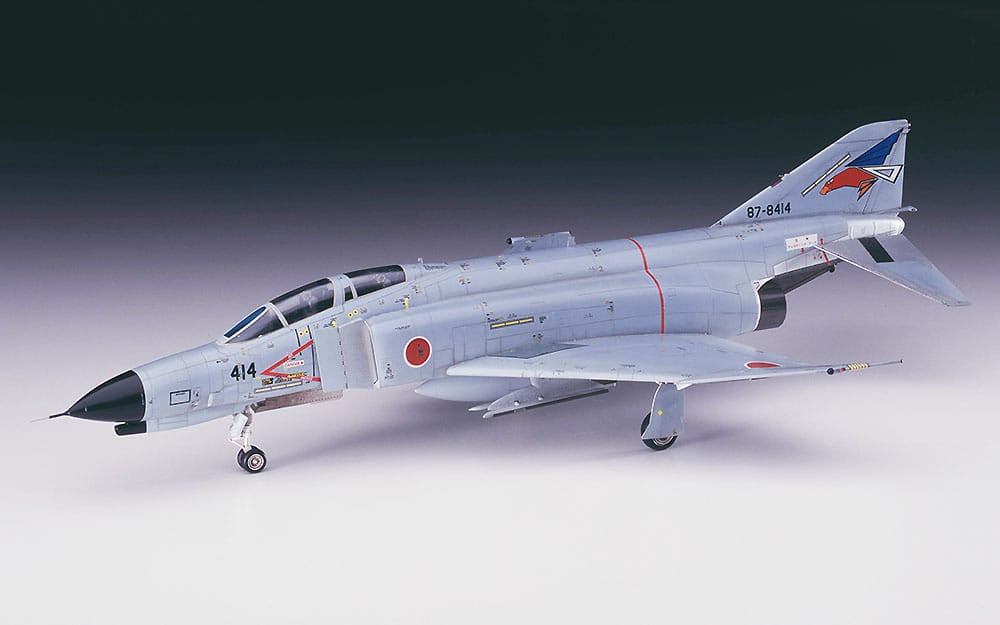
Mitsubishi F-4EJ Kai Phantom II
| type |
|---|
|
Plastic model kit |

This boxed set contains:
- 1 x Mitsubishi F-4EJ Kai Phantom II 1/72 scale multirole fighter aircraft [E Series]

Japanese Air Self-Defense Force

The F-4EJ Kai is a fighter of the Air Self-Defense Force developed from the F-4EJ Phantom II.
It was decided to adopt it as a successor of the F-86F in Showa43,
Since the F-4EJ, which began deployment in FY44, more than twenty years have passed since the introduction,
In order to measure the extension of the life and capacity of the aircraft, we have been conducting research and development since the 1950s.
As a result, we announced the renovation plan as F-4EJ reform in February 1958.
This renovation is mainly due to the improvement of combat capabilities and the adoption of the ASIP inspection method, which is a measure to prolong the life of the aircraft.
For the improvement of combat capabilities, first use the fire control radar.
The Westinghouse AN/APG-66 used in the F-16 was modified for the F-4EJ.
It is equipped with AN/APG-66J. This radar is from the reflection point of the Hakodate forced landing of MiG25
A small pulse-dip-propeller radar.
It is suitable for exploring aircraft flying at low altitudes over the sea from the sky.
Along with this, the onboard computer from the analog type to the previous
I changed it to a digital computer.
This allows for the integration of the weapons system.
It is also possible to operate domestic ASM1 anti-ship missiles.
The navigation system has also been changed from analog to digital.
The digitization of the inertial navigation equipment has greatly improved the accuracy of navigation,
There is also a target mark function that can mark the target point up to three places.
In addition, as a means of defense of this own aircraft, radar-warning equipment has been renovated to an enhanced type of capacity,
Detailed data is displayed on the CRT screen of the cockpit.
In addition, as a procedure to simplify the operation procedure of the pilot
Various operations can be performed while keeping your hands on the steering stick and throttle lever
The HOTAS concept is also adopted. In the absence of these renovations,
Adopted a new head-up display of the information- information-based data,
The pilot can read the data while facing the front.
The F-4EJ Kai adopted the ASIP aircraft management method as a measure to extend the life of the aircraft.
This is managed by a computer, the flight performance data of each aircraft,
It is a system that can individually manage the fatigue of each aircraft.
This ASIP method allows for an increase in life by about two thousand hours per aircraft.
F-4EJ reform is the main mission of the fighting force
Because the ground attack has also improved significantly compared to F-4EJ,
In order for the F1 of the support fighter to be retired from the future,
One squadron of F-4EJ changes is scheduled to take on a support combat mission.
(Information at the time of the kit release)
The data
Crew: Two people.
Total width: 11.77m
Total length: 12.2m
Height: 5.02m
Maximum take-off weight: 28,030kg
Engine: General Electric, Ishikawajima Harima Heavy Industries J79-GE/IHI-17×2
Thrust: 5,380kg (8,120kg when using A/B)
Max speed: Mach 2.2/11,000m
Fixed armament: M61A1 20mm Vulcan gun
First flight: 1984.7.17 (F-4EJ modified prototype)
Decal (marking)
83rd Air Squadron 302nd Squadron Aircraft ‘414‘ (Naha base)
The 6th Air Group, 306th Squadron, ‘416‘ (Komatsu Air Base)
5th Air Group 301 Squadron ‘417‘ (Nittawara Air Base)
This boxed set contains:
-
1*Mitsubishi F-4EJ Kai Phantom II 1/72 scale multirole fighter aircraft [E Series]
The F-4EJ Kai is a fighter of the Air Self-Defense Force developed from the F-4EJ Phantom II.
It was decided to adopt it as a successor of the F-86F in Showa43,
Since the F-4EJ, which began deployment in FY44, more than twenty years have passed since the introduction,
In order to measure the extension of the life and capacity of the aircraft, we have been conducting research and development since the 1950s.
As a result, we announced the renovation plan as F-4EJ reform in February 1958.
This renovation is mainly due to the improvement of combat capabilities and the adoption of the ASIP inspection method, which is a measure to prolong the life of the aircraft.
For the improvement of combat capabilities, first use the fire control radar.
The Westinghouse AN/APG-66 used in the F-16 was modified for the F-4EJ.
It is equipped with AN/APG-66J. This radar is from the reflection point of the Hakodate forced landing of MiG25
A small pulse-dip-propeller radar.
It is suitable for exploring aircraft flying at low altitudes over the sea from the sky.
Along with this, the onboard computer from the analog type to the previous
I changed it to a digital computer.
This allows for the integration of the weapons system.
It is also possible to operate domestic ASM1 anti-ship missiles.
The navigation system has also been changed from analog to digital.
The digitization of the inertial navigation equipment has greatly improved the accuracy of navigation,
There is also a target mark function that can mark the target point up to three places.
In addition, as a means of defense of this own aircraft, radar-warning equipment has been renovated to an enhanced type of capacity,
Detailed data is displayed on the CRT screen of the cockpit.
In addition, as a procedure to simplify the operation procedure of the pilot
Various operations can be performed while keeping your hands on the steering stick and throttle lever
The HOTAS concept is also adopted. In the absence of these renovations,
Adopted a new head-up display of the information- information-based data,
The pilot can read the data while facing the front.
The F-4EJ Kai adopted the ASIP aircraft management method as a measure to extend the life of the aircraft.
This is managed by a computer, the flight performance data of each aircraft,
It is a system that can individually manage the fatigue of each aircraft.
This ASIP method allows for an increase in life by about two thousand hours per aircraft.
F-4EJ reform is the main mission of the fighting force
Because the ground attack has also improved significantly compared to F-4EJ,
In order for the F1 of the support fighter to be retired from the future,
One squadron of F-4EJ changes is scheduled to take on a support combat mission.
(Information at the time of the kit release)
The data
Crew: Two people.
Total width: 11.77m
Total length: 12.2m
Height: 5.02m
Maximum take-off weight: 28,030kg
Engine: General Electric, Ishikawajima Harima Heavy Industries J79-GE/IHI-17×2
Thrust: 5,380kg (8,120kg when using A/B)
Max speed: Mach 2.2/11,000m
Fixed armament: M61A1 20mm Vulcan gun
First flight: 1984.7.17 (F-4EJ modified prototype)
Decal (marking)
83rd Air Squadron 302nd Squadron Aircraft ‘414‘ (Naha base)
The 6th Air Group, 306th Squadron, ‘416‘ (Komatsu Air Base)
5th Air Group 301 Squadron ‘417‘ (Nittawara Air Base)