Active Image
037987 - HMCC13 - Historic Car Series - primary image
Italy

Italy

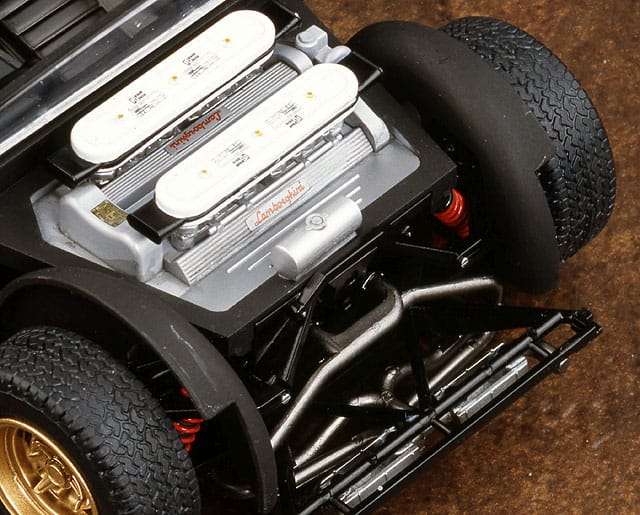
Lamborghini Miura P400SV (1971)

Sports Car · 1970s
Hasegawa · C13 · 1/24 · 2004
our price
£26.99 GBP
rrp
£29.99
you save
£3.00 (10%)
availability: order now! once in stock, this item will usually be dispatched within 2 working days.
shipping: worldwide this item can be sent anywhere in the world
Ausverkauft
add to wishlist
type

Plastic model kit

Vollständige Details anzeigen

This boxed set contains:

  • 1 x Lamborghini Miura P400SV (1971) 1/24 scale sports car [Historic Car Series]
1:
Civilian
Lamborghini Miura P400SV (1971)
Civilian
37987 - HMCC13 - Historic Car Series - painted model 37987 - HMCC13 - Historic Car Series - painted model 37987 - HMCC13 - Historic Car Series - painted model 37987 - HMCC13 - Historic Car Series - painted model 37987 - HMCC13 - Historic Car Series - painted model
The Lamborghini Miura was officially unveiled at the Geneva Motor Show in March 1966. Named ‘Miura‘ after Spain's bravest fighting bull, the car boasts a height of just 1,080mm, front and rear cowls that open and close like a racing car, and pop-up headlights with eyelash-like trim that became the Miura's defining feature. The development of the Miura was extremely difficult. The transversely mounted mid-engine proved unreliable, the high load on the rear wheels resulted in insufficient chassis rigidity, and handling flaws were evident. Gearbox problems and cabin vibration and noise were just some of the numerous issues. However, after its official announcement, the Miura's reputation soared. P400: Thus, the P400, still essentially a prototype, was transferred to the mass production program. In early 1968, the chassis rigidity, which had been lacking, was strengthened, and the improved handling contributed to a reduction in vibration and noise. From May of the same year, 70-profile tires were fitted, the suspension alignment was changed, and part of the front chassis was also redesigned. P400S: As an evolution of the P400, the main changes include an increase of 20 PS in maximum engine output and 2 kg-m in maximum torque, with the engine speed at which these are achieved being 400 rpm higher. The interior, which was unpopular in the P400, was also significantly improved. From April 1970, ventilated disc brakes were standard on both the front and rear. J: In the spring of 1970, a special car was built. While the basic design was the same as the production Miura, it was a complete racing machine. The body was made entirely of aluminum, the car weighed only 880 kg, and it was built in accordance with the vehicle regulations for the prototype class of Section J of the FIA ​​Sporting Code, hence the ‘J,‘ and it was later called the Jota. However, this one Jota, still in racing specifications, was delivered to a customer and was totaled in an accident on August 2, 1972, and scrapped. P400SV: In addition to the ‘J‘ which was totaled in an accident, the P400SV, which inherited the technology tested in the Jota, was produced in May 1971 at the owner's request. The engine was again upgraded, achieving an improvement of 35 PS and 3 kg-m compared to the early P400. The Lamborghini Miura has continued to evolve through the P400, P400S, and P400SV, giving rise to the racing-spec Jota, and its low, aggressive styling remains that of a supercar that is still incredibly popular. P400SV Overall length: 4,390mm Overall width: 1,780mm Wheelbase: 2,504mm, Tread (F/R): 1,412/1,540mm Engine type: Water-cooled 60-degree V12 4-valve DOHC, Bore x Stroke: Φ82.0 x 62.0mm Total displacement: 3,929cc Compression ratio: 10.7:1 Maximum output: 385PS/7,850rpm Vehicle weight: 1,305kg

This boxed set contains:

  • 1*Lamborghini Miura P400SV (1971) 1/24 scale sports car [Historic Car Series]
37987 - HMCC13 - Historic Car Series - painted model 37987 - HMCC13 - Historic Car Series - painted model 37987 - HMCC13 - Historic Car Series - painted model 37987 - HMCC13 - Historic Car Series - painted model 37987 - HMCC13 - Historic Car Series - painted model

The Lamborghini Miura was officially unveiled at the Geneva Motor Show in March 1966. Named ‘Miura‘ after Spain's bravest fighting bull, the car boasts a height of just 1,080mm, front and rear cowls that open and close like a racing car, and pop-up headlights with eyelash-like trim that became the Miura's defining feature. The development of the Miura was extremely difficult. The transversely mounted mid-engine proved unreliable, the high load on the rear wheels resulted in insufficient chassis rigidity, and handling flaws were evident. Gearbox problems and cabin vibration and noise were just some of the numerous issues. However, after its official announcement, the Miura's reputation soared. P400: Thus, the P400, still essentially a prototype, was transferred to the mass production program. In early 1968, the chassis rigidity, which had been lacking, was strengthened, and the improved handling contributed to a reduction in vibration and noise. From May of the same year, 70-profile tires were fitted, the suspension alignment was changed, and part of the front chassis was also redesigned. P400S: As an evolution of the P400, the main changes include an increase of 20 PS in maximum engine output and 2 kg-m in maximum torque, with the engine speed at which these are achieved being 400 rpm higher. The interior, which was unpopular in the P400, was also significantly improved. From April 1970, ventilated disc brakes were standard on both the front and rear. J: In the spring of 1970, a special car was built. While the basic design was the same as the production Miura, it was a complete racing machine. The body was made entirely of aluminum, the car weighed only 880 kg, and it was built in accordance with the vehicle regulations for the prototype class of Section J of the FIA ​​Sporting Code, hence the ‘J,‘ and it was later called the Jota. However, this one Jota, still in racing specifications, was delivered to a customer and was totaled in an accident on August 2, 1972, and scrapped. P400SV: In addition to the ‘J‘ which was totaled in an accident, the P400SV, which inherited the technology tested in the Jota, was produced in May 1971 at the owner's request. The engine was again upgraded, achieving an improvement of 35 PS and 3 kg-m compared to the early P400. The Lamborghini Miura has continued to evolve through the P400, P400S, and P400SV, giving rise to the racing-spec Jota, and its low, aggressive styling remains that of a supercar that is still incredibly popular. P400SV Overall length: 4,390mm Overall width: 1,780mm Wheelbase: 2,504mm, Tread (F/R): 1,412/1,540mm Engine type: Water-cooled 60-degree V12 4-valve DOHC, Bore x Stroke: Φ82.0 x 62.0mm Total displacement: 3,929cc Compression ratio: 10.7:1 Maximum output: 385PS/7,850rpm Vehicle weight: 1,305kg

Contact Us