

United States
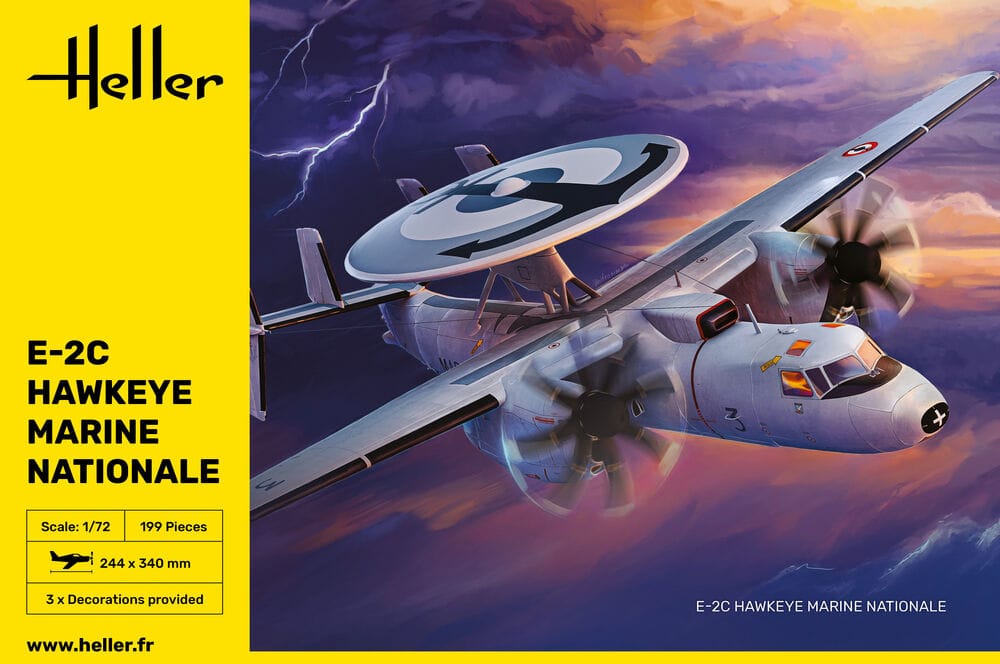
Grumman E-2C Hawkeye
| type | length | width |
|---|---|---|
|
Plastic model kit |
244mm |
340mm |

This boxed set contains:
- 1 x Grumman E-2C Hawkeye 1/72 scale naval airborne early warning and control aircraft

French Naval Air Arm
The Grumman E-2C Hawkeye is a carrier-borne early airborne warning aircraft designed to provide an extensive radar coverage to a combat task force. Thanks to its AN/APS-
145 rotating radar housed in its dorsal rotodome, it can detect and track up to 2,000 targets as far as 250 nautical miles on 360°. The radar is linked to an AN/ALQ-217 ESM
passive sensor able to locate and identify radars within range, broadening the on-site commanders’ tactical view.
The French Naval Aviation has three of these aircraft, which can be deployed on the Charles de Gaulle nuclear aircraft carrier. The first two aircraft were delivered to the E-2C
standard in December 1998 and April 1999 to fleet squadron 4F at Lann-Bihoué, and they were joined in February 2004 by a third aircraft, which was delivered directly to the
E-2C+ Hawkeye 2000 standard, a version recognisable by its Collins NP2000 electronically controlled eight-blade composite propellers. Hawkeye Nos. 1 and 2 were upgraded
to this standard in 2006 and 2007 respectively, harmonising the configuration of the three planes for better performance and simplified maintenance.
In addition to the pilot and co-pilot, the tactical section in the rear compartment houses three weapons systems officers manning modern on-board electronics and numerous
means of communication and data links 11 and 16, as well as the Fleet-Satcom satellite link provided by an antenna located in the centre of the radome. The interface is provided
by new Famous consoles, which enable them to carry out control, command and electronic intelligence missions for French and allied forces.
Call-signed ‘Damo’, the French Hawkeyes were first deployed on the Charles de Gaulle in July 2001 before sailing for the Heracles mission to the Arabian Gulf and Afghanistan,
operating in conjunction with the E-2Cs of the American super-aircraft carrier USS John C. Stennis. After several deployments during the Agapanthe and Enduring Freedom
missions, as well as exercises with various allied forces in the Indian Ocean and the Persian Gulf operating zones, the Hawkeyes were sent ashore during the Charles de Gaulle's
Indisponibilité Pour Entretien et Réparation (IPER, maintenance and repair period). The radar aircraft therefore operated from land bases, ensuring the operational continuity
of the fleet and carrying out other types of early warning and control missions. For example, in 2008, two of the aircraft took part in the fight against drug trafficking in the
Caribbean alongside US Navy units, even embarking on US Navy supercarriers.
The French Hawkeyes were modernised between 2017 and 2019, notably to upgrade the avionics and bring them in line with International Civil Aviation Organisation standards.
Electronic performances were also enhanced to improve signal processing and coastal detection capabilities. Now reaching reach their age limit, the three French E-2C+
aircraft will be replaced by 2030 by in-flight-refuellable E-2D Advanced Hawkeyes.
This boxed set contains:
-
1*Grumman E-2C Hawkeye 1/72 scale naval airborne early warning and control aircraft
The Grumman E-2C Hawkeye is a carrier-borne early airborne warning aircraft designed to provide an extensive radar coverage to a combat task force. Thanks to its AN/APS-
145 rotating radar housed in its dorsal rotodome, it can detect and track up to 2,000 targets as far as 250 nautical miles on 360°. The radar is linked to an AN/ALQ-217 ESM
passive sensor able to locate and identify radars within range, broadening the on-site commanders’ tactical view.
The French Naval Aviation has three of these aircraft, which can be deployed on the Charles de Gaulle nuclear aircraft carrier. The first two aircraft were delivered to the E-2C
standard in December 1998 and April 1999 to fleet squadron 4F at Lann-Bihoué, and they were joined in February 2004 by a third aircraft, which was delivered directly to the
E-2C+ Hawkeye 2000 standard, a version recognisable by its Collins NP2000 electronically controlled eight-blade composite propellers. Hawkeye Nos. 1 and 2 were upgraded
to this standard in 2006 and 2007 respectively, harmonising the configuration of the three planes for better performance and simplified maintenance.
In addition to the pilot and co-pilot, the tactical section in the rear compartment houses three weapons systems officers manning modern on-board electronics and numerous
means of communication and data links 11 and 16, as well as the Fleet-Satcom satellite link provided by an antenna located in the centre of the radome. The interface is provided
by new Famous consoles, which enable them to carry out control, command and electronic intelligence missions for French and allied forces.
Call-signed ‘Damo’, the French Hawkeyes were first deployed on the Charles de Gaulle in July 2001 before sailing for the Heracles mission to the Arabian Gulf and Afghanistan,
operating in conjunction with the E-2Cs of the American super-aircraft carrier USS John C. Stennis. After several deployments during the Agapanthe and Enduring Freedom
missions, as well as exercises with various allied forces in the Indian Ocean and the Persian Gulf operating zones, the Hawkeyes were sent ashore during the Charles de Gaulle's
Indisponibilité Pour Entretien et Réparation (IPER, maintenance and repair period). The radar aircraft therefore operated from land bases, ensuring the operational continuity
of the fleet and carrying out other types of early warning and control missions. For example, in 2008, two of the aircraft took part in the fight against drug trafficking in the
Caribbean alongside US Navy units, even embarking on US Navy supercarriers.
The French Hawkeyes were modernised between 2017 and 2019, notably to upgrade the avionics and bring them in line with International Civil Aviation Organisation standards.
Electronic performances were also enhanced to improve signal processing and coastal detection capabilities. Now reaching reach their age limit, the three French E-2C+
aircraft will be replaced by 2030 by in-flight-refuellable E-2D Advanced Hawkeyes.