

United Kingdom
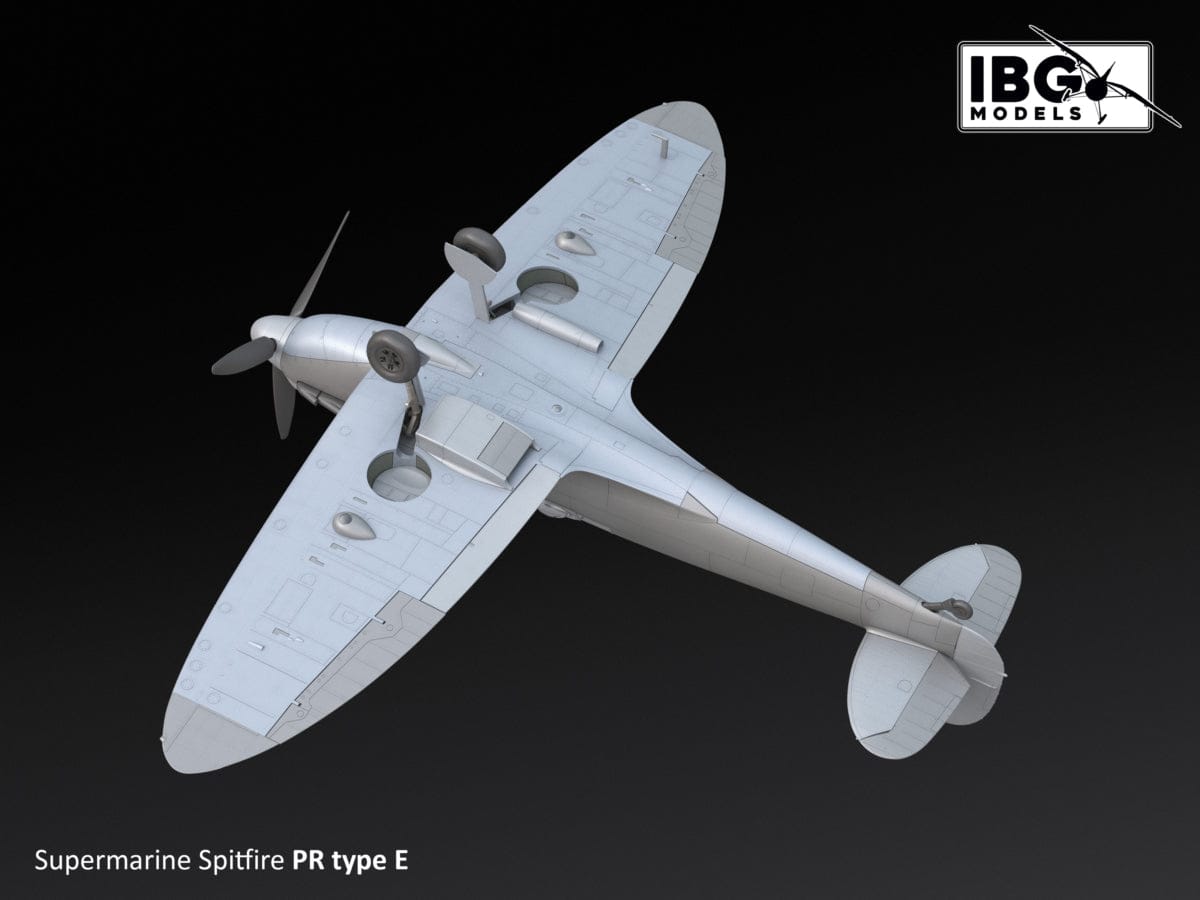
Supermarine Spitfire Mk I PR A/B/E
| type |
|---|
|
Plastic model kit |

This boxed set contains:
- 1 x Supermarine Spitfire Mk I PR A/B/E 1/72 scale fighter aircraft


British Royal Air Force


The Supermarine Spitfire is without doubt one of the most iconic and recognisable aircraft of the Second World War. While its story spans the entirety of the conflict—from the earliest days to the final victory—it was the early variants powered by the Rolls-Royce Merlin engine with a single-stage supercharger that laid the foundations of the modern Royal Air Force, both technologically and symbolically.
The reconnaissance variants of the Spitfire, including the PR.A,B and E, played a crucial yet often underappreciated role during the war. The PR version was created by adapting standard fighter models—stripping away armament to reduce weight and increase range, installing specialized high-resolution cameras, and adding additional fuel tanks. These modifications allowed the Spitfire PR to operate at high altitudes and deep behind enemy lines, carrying out missions that were indispensable for Allied strategic planning.
The origins of Spitfire reconnaissance trace back to the uncertain months of the Phoney War in late 1939 and early 1940. As large-scale ground combat stalled on the Western Front, RAF commanders realized the urgent need for updated intelligence on German positions beyond the Siegfried Line. Early PR variants—Type A, Type B, and Type E—were pressed into service. Based on standard Mk I fighters, these conversions carried minimal extra fuel and simple camera installations, yet they represented a dramatic leap forward in aerial reconnaissance capabilities. Flying from improvised bases in France, often alongside the British Expeditionary Force, these early PR Spitfires undertook daring solo missions deep over German-occupied territory. Their pilots operated without escort, relying on speed, altitude, and stealth to avoid interception. As the German Blitzkrieg finally erupted in May 1940, the reconnaissance Spitfires became critical eyes in the sky—photographing advancing Panzer divisions, troop concentrations, and vital crossings over the Meuse and Somme rivers. Their images proved invaluable during the desperate defense of France and the evacuation at Dunkirk, where up-to-date intelligence on enemy movements was essential to organizing the safe withdrawal of Allied forces. Though primitive compared to later specialized reconnaissance aircraft, these first PR Spitfires set a standard of bravery and innovation that would define RAF photo-reconnaissance efforts throughout the war.
This boxed set contains:
-
1*Supermarine Spitfire Mk I PR A/B/E 1/72 scale fighter aircraft
The Supermarine Spitfire is without doubt one of the most iconic and recognisable aircraft of the Second World War. While its story spans the entirety of the conflict—from the earliest days to the final victory—it was the early variants powered by the Rolls-Royce Merlin engine with a single-stage supercharger that laid the foundations of the modern Royal Air Force, both technologically and symbolically.
The reconnaissance variants of the Spitfire, including the PR.A,B and E, played a crucial yet often underappreciated role during the war. The PR version was created by adapting standard fighter models—stripping away armament to reduce weight and increase range, installing specialized high-resolution cameras, and adding additional fuel tanks. These modifications allowed the Spitfire PR to operate at high altitudes and deep behind enemy lines, carrying out missions that were indispensable for Allied strategic planning.
The origins of Spitfire reconnaissance trace back to the uncertain months of the Phoney War in late 1939 and early 1940. As large-scale ground combat stalled on the Western Front, RAF commanders realized the urgent need for updated intelligence on German positions beyond the Siegfried Line. Early PR variants—Type A, Type B, and Type E—were pressed into service. Based on standard Mk I fighters, these conversions carried minimal extra fuel and simple camera installations, yet they represented a dramatic leap forward in aerial reconnaissance capabilities. Flying from improvised bases in France, often alongside the British Expeditionary Force, these early PR Spitfires undertook daring solo missions deep over German-occupied territory. Their pilots operated without escort, relying on speed, altitude, and stealth to avoid interception. As the German Blitzkrieg finally erupted in May 1940, the reconnaissance Spitfires became critical eyes in the sky—photographing advancing Panzer divisions, troop concentrations, and vital crossings over the Meuse and Somme rivers. Their images proved invaluable during the desperate defense of France and the evacuation at Dunkirk, where up-to-date intelligence on enemy movements was essential to organizing the safe withdrawal of Allied forces. Though primitive compared to later specialized reconnaissance aircraft, these first PR Spitfires set a standard of bravery and innovation that would define RAF photo-reconnaissance efforts throughout the war.