

United States
Curtiss P-36A Hawk
| type |
|---|
|
Plastic model kit |


This boxed set contains:
- 1 x Curtiss P-36A Hawk 1/72 scale fighter aircraft


United States Army Air Forces
In 1935, a modern all-metal monoplane fighter with retractable landing gear took to the skies for the first time. Designed by Curtiss-Wright for a U.S. Army Air Corps competition, it was designated Curtiss Hawk Model 75 by the manufacturer. After refinement, it entered service with the designation P-36A. The aircraft featured excellent performance and exceptional maneuverability—outclassing even some later designs like the Bf 109 and Hurricane in turning combat.
By the end of the 1930s, the USAAC had acquired 180 P-36A fighters, which were widely used by pursuit squadrons across the continental United States, Hawaii, Alaska, and the Panama Canal Zone. When the Pacific War began, the P-36A was still in front-line service, although it was gradually being transferred to training and second-line units. The type played a significant role in preparing U.S. pilots for combat in more advanced fighter aircraft.
During the Japanese attack on Pearl Harbor on December 7, 1941, five P-36A fighters from the 46th Pursuit Squadron managed to take off in response to the alarm. Among the pilots was 2nd Lt. Phillip Rasmussen, who scrambled in his pajamas with only minimal armament and scored one of the first American aerial victories of World War II, most likely shooting down an A6M2 Zero.
Approximately 1,000 Curtiss P-36 aircraft were produced in all variants. They were powered by Pratt & Whitney R-1830 Twin Wasp or Wright R-1820 Cyclone radial engines, depending on the version and export contract. After adapting the airframe for the Allison V-1710 inline engine, a new and more advanced fighter emerged: the Curtiss P-40, which became a key asset for the USAAF and was produced in over 13,000 examples.
American version of the Curtiss P-36A Hawk
All-new tooling – 2025 release
Kit contents:
Injection-moulded plastic parts (2 grey sprues and 1 clear)
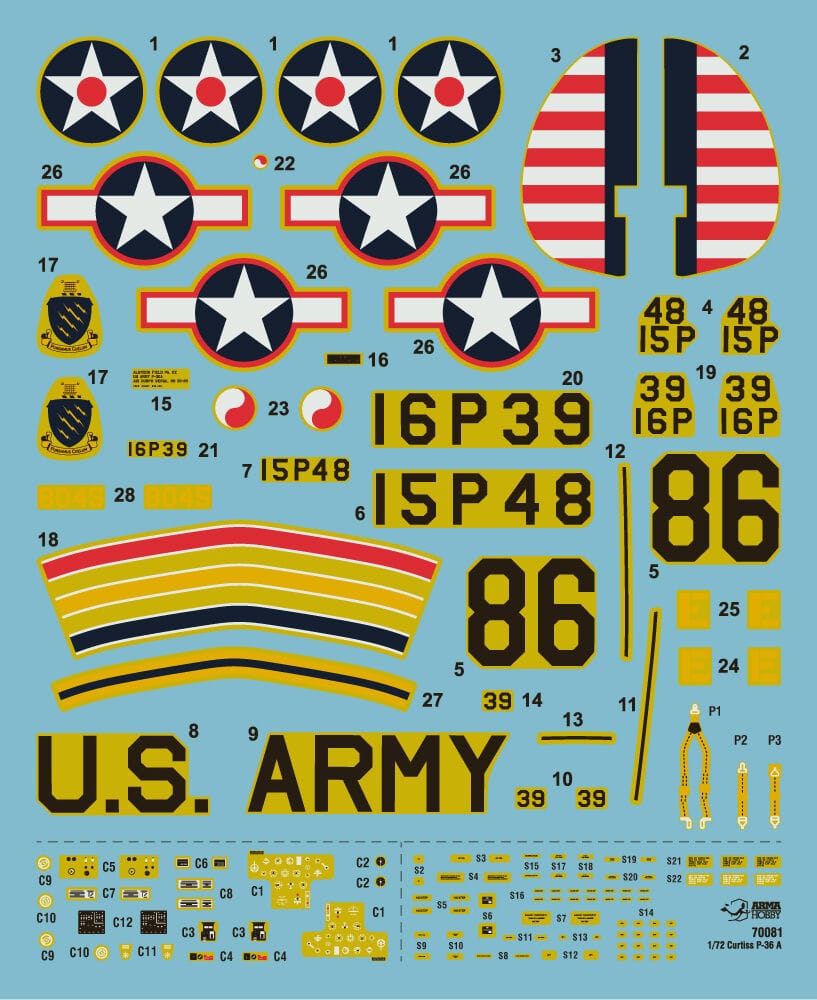
Decals for three marking options
Pre-cut painting masks for canopy and wheels
Assembly instructions
Free 3D-print file with additional details
Free 3D-print file
Available via QR code or direct link in the instruction manual
3D file contents:
Pilot’s seat with seatbelts
Fuselage bulkhead
Instrument panel
Exhaust pipes
Marking options:
Curtiss P-36A, pilot: 2/Lt. Phillip Rasmussen, 46th Pursuit Squadron, 15th Pursuit Group, Wheeler Field, Hawaii, 7 December 1941
Curtiss P-36A, Headquarters Squadron, 16th |Pursuit Group, Rio Hato Aerodrome, Panama 1941
Curtiss P-36A, VII Air Force Gunnery School, Hickam Field, Hawaii 1943
This boxed set contains:
-
1*Curtiss P-36A Hawk 1/72 scale fighter aircraft
In 1935, a modern all-metal monoplane fighter with retractable landing gear took to the skies for the first time. Designed by Curtiss-Wright for a U.S. Army Air Corps competition, it was designated Curtiss Hawk Model 75 by the manufacturer. After refinement, it entered service with the designation P-36A. The aircraft featured excellent performance and exceptional maneuverability—outclassing even some later designs like the Bf 109 and Hurricane in turning combat.
By the end of the 1930s, the USAAC had acquired 180 P-36A fighters, which were widely used by pursuit squadrons across the continental United States, Hawaii, Alaska, and the Panama Canal Zone. When the Pacific War began, the P-36A was still in front-line service, although it was gradually being transferred to training and second-line units. The type played a significant role in preparing U.S. pilots for combat in more advanced fighter aircraft.
During the Japanese attack on Pearl Harbor on December 7, 1941, five P-36A fighters from the 46th Pursuit Squadron managed to take off in response to the alarm. Among the pilots was 2nd Lt. Phillip Rasmussen, who scrambled in his pajamas with only minimal armament and scored one of the first American aerial victories of World War II, most likely shooting down an A6M2 Zero.
Approximately 1,000 Curtiss P-36 aircraft were produced in all variants. They were powered by Pratt & Whitney R-1830 Twin Wasp or Wright R-1820 Cyclone radial engines, depending on the version and export contract. After adapting the airframe for the Allison V-1710 inline engine, a new and more advanced fighter emerged: the Curtiss P-40, which became a key asset for the USAAF and was produced in over 13,000 examples.
American version of the Curtiss P-36A Hawk
All-new tooling – 2025 release
Kit contents:
Injection-moulded plastic parts (2 grey sprues and 1 clear)
Decals for three marking options
Pre-cut painting masks for canopy and wheels
Assembly instructions
Free 3D-print file with additional details
Free 3D-print file
Available via QR code or direct link in the instruction manual
3D file contents:
Pilot’s seat with seatbelts
Fuselage bulkhead
Instrument panel
Exhaust pipes
Marking options:
Curtiss P-36A, pilot: 2/Lt. Phillip Rasmussen, 46th Pursuit Squadron, 15th Pursuit Group, Wheeler Field, Hawaii, 7 December 1941
Curtiss P-36A, Headquarters Squadron, 16th |Pursuit Group, Rio Hato Aerodrome, Panama 1941
Curtiss P-36A, VII Air Force Gunnery School, Hickam Field, Hawaii 1943