

United States
Curtiss P-36C Hawk
| type |
|---|
|
Plastic model kit |


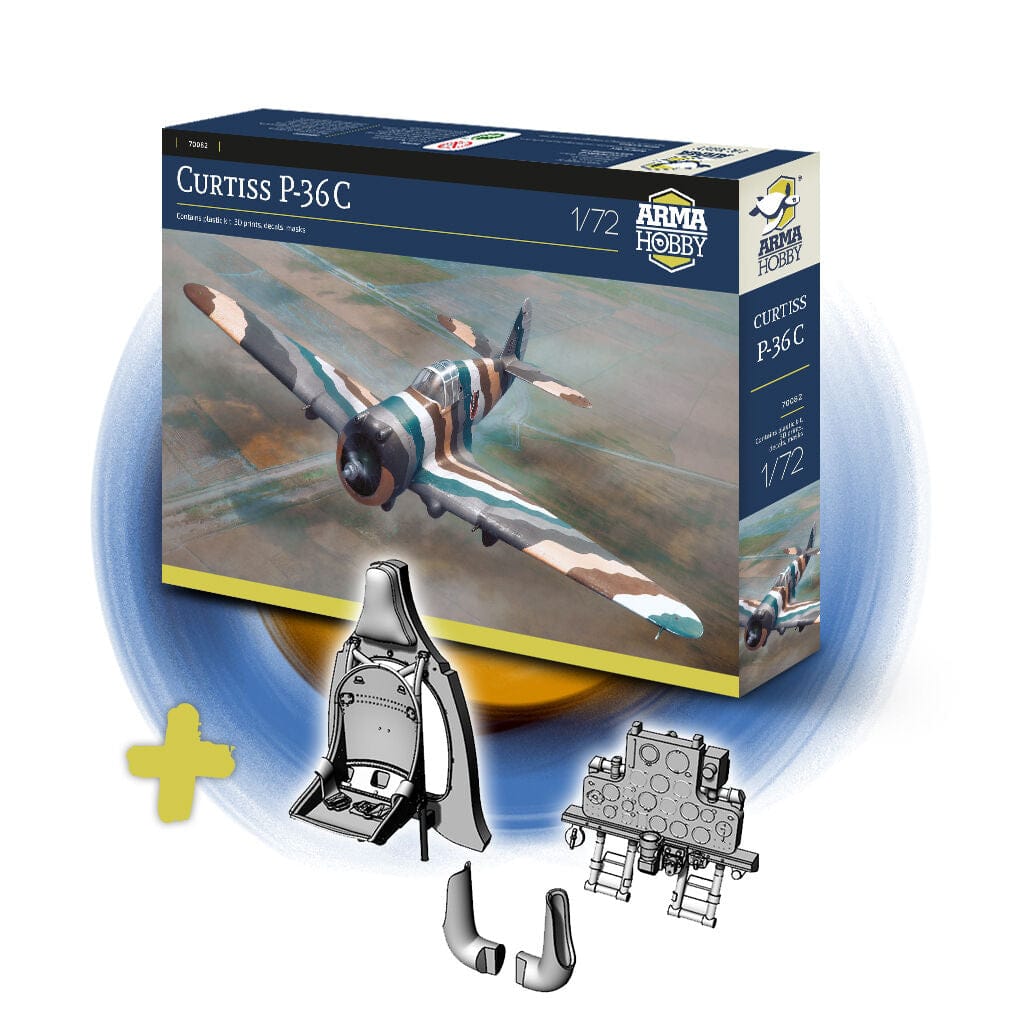
This boxed set contains:
- 1 x Curtiss P-36C Hawk 1/72 scale fighter aircraft


United States Army Air Corps


Model of an aircraft from the final production series of the P-36A, featuring additional wing-mounted armament. Used for training and camouflage testing, it offers a visually appealing variety of paint schemes.
In the box you will find:
plastic sprues (2 grey and 1 clear)
3D-printed ammunition boxes for the wing machine guns
decals for three marking options
painting masks for the cockpit and wheels
instruction booklet
3D file for self-printing additional details
Free 3D self-printing file
Available for download via QR code or link provided in the model instructions.
3D file contents:
pilot’s seat with harness, fuselage bulkhead, instrument panel, exhaust pipes
Marking options:
Curtiss P-36C, 27th Pursuit Squadron, 1st Pursuit Group,
National Air Races, Cleveland, Ohio, September 1939
Aircraft finished in one of the most distinctive experimental camouflage schemes used by the 27th PS. The temporary, high-contrast paintwork was intended for display purposes and formed part of trials conducted prior to the introduction of standard wartime camouflage schemes.
Curtiss P-36C, 27th Pursuit Squadron, USAAC,
Selfridge Field, Michigan, 1939
Aircraft photographed before the application of display camouflage, finished in the uniform, classic scheme used by frontline units. An example of the early appearance of the P-36C before the intensive camouflage testing phase.
Curtiss P-36C, 23rd Composite Group,
Eglin Field, Florida, 1941-1942
Aircraft used for intensive training and test flights. The unit took part in training interception exercises involving B-25B bombers from James H. Doolittle’s unit, prior to the Tokyo raid in April 1942. The provisional camouflage and visible wear are the result of frequent flying and repeated repainting.
Curtiss P-36C Hawk – a short production run at the dawn of a new era
The Curtiss P-36 Hawk was the first modern American fighter aircraft introduced into frontline service with the USAAC. It was developed in response to rapid changes in global military aviation during the second half of the 1930s and marked a clear departure from earlier biplane designs. Retractable landing gear, an enclosed cockpit, and an all-metal airframe made it the starting point for subsequent generations of American fighter aircraft.
The P-36C version represented the final stage of development of the design and was produced in a very limited run. The final thirty aircraft were completed to a new standard, featuring the Pratt & Whitney R-1830-17 engine rated at 1,200 hp and reinforced armament. Aircraft of this version received additional 0.30-calibre machine guns in the wings, with distinctive external ammunition boxes mounted beneath the wing panels, becoming one of the most easily recognisable features of the P-36C.
The small number of aircraft produced meant that P-36Cs did not form separate, uniform units but were instead dispersed among squadrons operating primarily earlier P-36A aircraft. Their largest concentration was within the 27th Pursuit Squadron, which became a natural base for operational trials and testing of new solutions, including camouflage schemes.
It was the aircraft of the 27th Pursuit Squadron that played a key role in experimental camouflage programmes conducted in 1939. The culmination of these efforts was the participation of P-36Cs in the National Air Races held in September 1939 in Cleveland, Ohio. The aircraft displayed there attracted attention with bold, high-contrast and often temporary camouflage schemes, applied without uniform guidelines and treated as a testing ground for future standards.
As a result, the Curtiss P-36C entered history as one of the most ambiguous and visually diverse Hawk variants. The short production run, dispersal among units and intensive testing meant that nearly every aircraft differed in equipment details and external appearance, making this version particularly attractive to researchers and modelers interested in the transitional period in the development of American fighter
This boxed set contains:
-
1*Curtiss P-36C Hawk 1/72 scale fighter aircraft
Model of an aircraft from the final production series of the P-36A, featuring additional wing-mounted armament. Used for training and camouflage testing, it offers a visually appealing variety of paint schemes.
In the box you will find:
plastic sprues (2 grey and 1 clear)
3D-printed ammunition boxes for the wing machine guns
decals for three marking options
painting masks for the cockpit and wheels
instruction booklet
3D file for self-printing additional details
Free 3D self-printing file
Available for download via QR code or link provided in the model instructions.
3D file contents:
pilot’s seat with harness, fuselage bulkhead, instrument panel, exhaust pipes
Marking options:
Curtiss P-36C, 27th Pursuit Squadron, 1st Pursuit Group,
National Air Races, Cleveland, Ohio, September 1939
Aircraft finished in one of the most distinctive experimental camouflage schemes used by the 27th PS. The temporary, high-contrast paintwork was intended for display purposes and formed part of trials conducted prior to the introduction of standard wartime camouflage schemes.
Curtiss P-36C, 27th Pursuit Squadron, USAAC,
Selfridge Field, Michigan, 1939
Aircraft photographed before the application of display camouflage, finished in the uniform, classic scheme used by frontline units. An example of the early appearance of the P-36C before the intensive camouflage testing phase.
Curtiss P-36C, 23rd Composite Group,
Eglin Field, Florida, 1941-1942
Aircraft used for intensive training and test flights. The unit took part in training interception exercises involving B-25B bombers from James H. Doolittle’s unit, prior to the Tokyo raid in April 1942. The provisional camouflage and visible wear are the result of frequent flying and repeated repainting.
Curtiss P-36C Hawk – a short production run at the dawn of a new era
The Curtiss P-36 Hawk was the first modern American fighter aircraft introduced into frontline service with the USAAC. It was developed in response to rapid changes in global military aviation during the second half of the 1930s and marked a clear departure from earlier biplane designs. Retractable landing gear, an enclosed cockpit, and an all-metal airframe made it the starting point for subsequent generations of American fighter aircraft.
The P-36C version represented the final stage of development of the design and was produced in a very limited run. The final thirty aircraft were completed to a new standard, featuring the Pratt & Whitney R-1830-17 engine rated at 1,200 hp and reinforced armament. Aircraft of this version received additional 0.30-calibre machine guns in the wings, with distinctive external ammunition boxes mounted beneath the wing panels, becoming one of the most easily recognisable features of the P-36C.
The small number of aircraft produced meant that P-36Cs did not form separate, uniform units but were instead dispersed among squadrons operating primarily earlier P-36A aircraft. Their largest concentration was within the 27th Pursuit Squadron, which became a natural base for operational trials and testing of new solutions, including camouflage schemes.
It was the aircraft of the 27th Pursuit Squadron that played a key role in experimental camouflage programmes conducted in 1939. The culmination of these efforts was the participation of P-36Cs in the National Air Races held in September 1939 in Cleveland, Ohio. The aircraft displayed there attracted attention with bold, high-contrast and often temporary camouflage schemes, applied without uniform guidelines and treated as a testing ground for future standards.
As a result, the Curtiss P-36C entered history as one of the most ambiguous and visually diverse Hawk variants. The short production run, dispersal among units and intensive testing meant that nearly every aircraft differed in equipment details and external appearance, making this version particularly attractive to researchers and modelers interested in the transitional period in the development of American fighter