

Japan
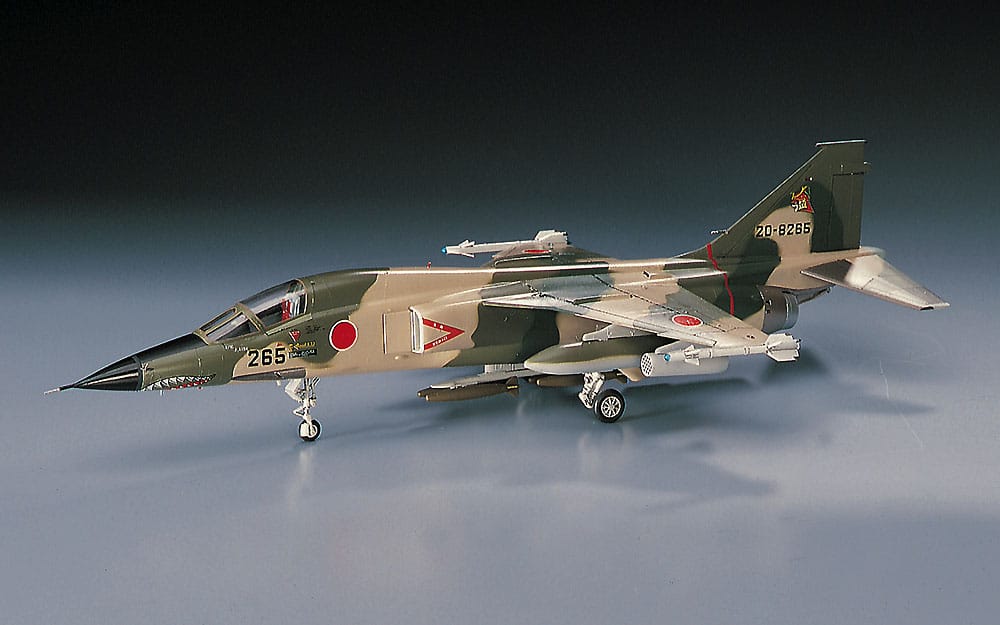
Mitsubishi F-1
| type |
|---|
|
Plastic model kit |

This boxed set contains:
- 1 x Mitsubishi F-1 1/72 scale attacker aircraft [C Series]

Japanese Air Self-Defense Force

The Mitsubishi F-1 is a support fighter for the Air Self-Defense Force developed from the T-2s, a training aircraft.
As the first domestic supersonic jet fighter,
We started procurement in the 1950s, including development in the 1970s.
In the past, the F-86F was used as a support fighter.
In order to carry out full-scale support fighter aircraft operation, the Air Self-Defense Force
The introduction of the F-5E Tiger II was also considered,
It was decided to propose the modification of the fighter of the T-2 trainer, which was in the operation stage at that time.
Development of FS-T2 reform (later F-1) has started,
For this reason, the 106th and 107th T-2s were completed as T-2s special specifications for flight testing.
We conducted various system tests and flight tests.
Based on the results of these various tests, the approval of the use of troops by the head of the Defense Agency was approved on November 14th,
At the same time, the official name of the support fighter F1 was decided from the FS-T2 revision.
The F1 deployment began in the 52nd year, and the 3rd Squadron of Misawa Air Base, 8th Squadron,
The 6th Squadron of Tsuiki Base was deployed sequentially instead of the F-86F.
The F1 is a support fighter, but it is also used as a warning fighter for operation.
For this reason, a variety of weapons are attached.
Air-to-air missile side winder, during the key strike mission,
In the case of support combat, 500lb bombs, anti-ship missiles, 70mm or 127mm rockets, etc. are installed.
In order to perform such a variety of missions, F1 was modified from T-2,
Enhanced search tracking radar, radio altimetrium and atmospheric various-pointed calculators,
Equipped with radar warning equipment, strike camera, etc.,
We are doing additional remodeling such as installation pylons of armed relations.
In such a modification, in addition, as a characteristic of F1
There are J/AWG-12 radar and J/ASQ-1 control calculator.
This device is an important device for performing accurate bombing.
Radar, Head-Up Display (HUD), Inertial Navigation Equipment, Radio Altitude,
It calculates information from atmospheric various-dimensional computers, etc. and outputs the optimal information to HUD and radar.
In addition, this device has an automatic mode, projecting the landing point and the flight path to the HUD,
When the pilot executes the bullet, it calculates the optimal timing of the bullet and automatically throws it.
The F1 was installed with an autopilot from the mid-1950s, in the middle of production.
Until then, it can now be installed on the aircraft for regular repairs.
This allowed the pilot to carry out a low and reliable attack mission.
In addition, due to the nature of the mission, there are many ultra-low flying,
The collision with the bird was a problem, but the fixed windshield was made of sturdy polycarbonate
It was solved by making it a one-piece canopy that lost the frame.
The data
Crew: one.
Total width: 7.88m
Length: 17.85m
Height: 4.45m
Maximum take-off weight: 13,700kg
Engine: TF-40-IHI-801A Adore
Thrust: 2,136kg (3,207kg when using A/B) x 2
Max speed: Mach 1.6/11,000m
Fixed armament: M61 A1 20mm Vulcan gun
First flight: 1977.6.16 (FS-T2 reformed)
This boxed set contains:
-
1*Mitsubishi F-1 1/72 scale attacker aircraft [C Series]
The Mitsubishi F-1 is a support fighter for the Air Self-Defense Force developed from the T-2s, a training aircraft.
As the first domestic supersonic jet fighter,
We started procurement in the 1950s, including development in the 1970s.
In the past, the F-86F was used as a support fighter.
In order to carry out full-scale support fighter aircraft operation, the Air Self-Defense Force
The introduction of the F-5E Tiger II was also considered,
It was decided to propose the modification of the fighter of the T-2 trainer, which was in the operation stage at that time.
Development of FS-T2 reform (later F-1) has started,
For this reason, the 106th and 107th T-2s were completed as T-2s special specifications for flight testing.
We conducted various system tests and flight tests.
Based on the results of these various tests, the approval of the use of troops by the head of the Defense Agency was approved on November 14th,
At the same time, the official name of the support fighter F1 was decided from the FS-T2 revision.
The F1 deployment began in the 52nd year, and the 3rd Squadron of Misawa Air Base, 8th Squadron,
The 6th Squadron of Tsuiki Base was deployed sequentially instead of the F-86F.
The F1 is a support fighter, but it is also used as a warning fighter for operation.
For this reason, a variety of weapons are attached.
Air-to-air missile side winder, during the key strike mission,
In the case of support combat, 500lb bombs, anti-ship missiles, 70mm or 127mm rockets, etc. are installed.
In order to perform such a variety of missions, F1 was modified from T-2,
Enhanced search tracking radar, radio altimetrium and atmospheric various-pointed calculators,
Equipped with radar warning equipment, strike camera, etc.,
We are doing additional remodeling such as installation pylons of armed relations.
In such a modification, in addition, as a characteristic of F1
There are J/AWG-12 radar and J/ASQ-1 control calculator.
This device is an important device for performing accurate bombing.
Radar, Head-Up Display (HUD), Inertial Navigation Equipment, Radio Altitude,
It calculates information from atmospheric various-dimensional computers, etc. and outputs the optimal information to HUD and radar.
In addition, this device has an automatic mode, projecting the landing point and the flight path to the HUD,
When the pilot executes the bullet, it calculates the optimal timing of the bullet and automatically throws it.
The F1 was installed with an autopilot from the mid-1950s, in the middle of production.
Until then, it can now be installed on the aircraft for regular repairs.
This allowed the pilot to carry out a low and reliable attack mission.
In addition, due to the nature of the mission, there are many ultra-low flying,
The collision with the bird was a problem, but the fixed windshield was made of sturdy polycarbonate
It was solved by making it a one-piece canopy that lost the frame.
The data
Crew: one.
Total width: 7.88m
Length: 17.85m
Height: 4.45m
Maximum take-off weight: 13,700kg
Engine: TF-40-IHI-801A Adore
Thrust: 2,136kg (3,207kg when using A/B) x 2
Max speed: Mach 1.6/11,000m
Fixed armament: M61 A1 20mm Vulcan gun
First flight: 1977.6.16 (FS-T2 reformed)