

Japan
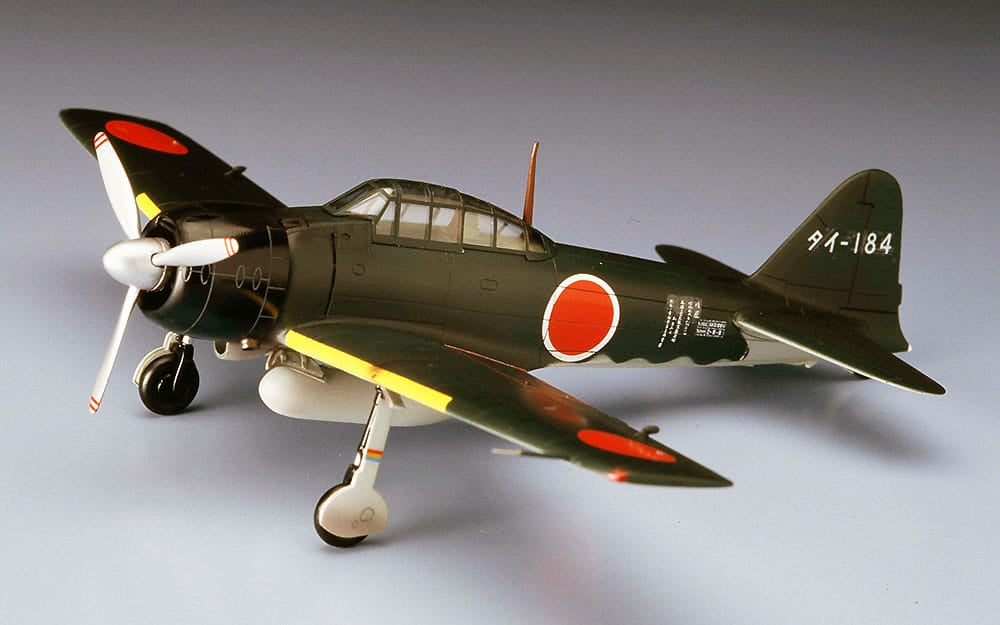
Mitsubishi A6M3 Zero Model 22/32 ‘Zeke’
| type |
|---|
|
Plastic model kit |

This boxed set contains:
- 1 x Mitsubishi A6M3 Zero Model 22/32 ‘Zeke’ 1/72 scale naval fighter aircraft [D Series]

Imperial Japanese Navy Air Service

Because it proved to be such an excellent fighter, both the manufacturer and the military sought even greater performance. In early Showa 16 (1941), roughly one year before the outbreak of the Pacific War, development of the A6M3 — including an engine upgrade — began.
The main objectives were to improve high-altitude performance by replacing the engine, enhance roll rate and speed by deleting the wing-folding mechanism, and improve productivity and maintainability.
The new engine was the Sakae 21, equipped with a one-stage, two-speed supercharger. To handle the increased power, a larger Hamilton Standard propeller (15 cm greater in diameter) was fitted. Although engine output improved, the weight also increased significantly. Combined with major changes to the engine mount and fuselage structure, the overall fuselage was shortened compared to the previous A6M2 (Type 21). The cowling was redesigned for better aerodynamic performance, and the carburetor intake was relocated from the bottom to the top of the cowling.
The wings were shortened by a total of 1 meter and given square tips. The 20 mm wing cannons were upgraded to the longer-barreled Type 99 Mk.2.
The renovated A6M3 made its maiden flight on July 14. After a series of tests, it was officially adopted by the Imperial Japanese Navy as the Type 0 Carrier Fighter Model 32 and deployed to the Southwest Pacific, particularly the Solomon Islands area.
While speed and roll rate were improved, the excellent horizontal maneuverability and long cruising range — the Zero’s greatest strengths — were significantly reduced. This was not a major problem initially, but it became critical once long-range operations from Rabaul to Guadalcanal began.
To restore cruising performance, the wingspan was returned to 12 meters and additional fuel tanks were installed in the outer wings. This enhanced variant was adopted as the Type 0 Carrier Fighter Model 22.
The Model 22 offered significantly better range than the Model 32. As a result, the newer Model 32 was soon reassigned to training units, while the Model 22 became the primary fighter used in the Solomons air battles. In both variants, the wing armament was changed to the long-barreled Type 99 Mk.2 20 mm cannons.
Data: Mitsubishi Type 0 Carrier Fighter (Model 21)
Crew: 1
Wingspan: 12.00 m
Length: 9.060 m
Height: 3.570 m
Maximum speed: 540.8 km/h (at 6,000 m)
Engine: Sakae 12 (approx. 950 hp)
Armament: 2 × 7.7 mm machine guns + 2 × 20 mm cannons
Data: Mitsubishi Type 0 Carrier Fighter Model 32
Crew: 1
Wingspan: 11.00 m
Length: 9.060 m
Height: 3.570 m
Maximum speed: 544.5 km/h (at 6,000 m)
Engine: Sakae 21 (1,130 hp takeoff power)
Armament: 2 × 7.7 mm machine guns + 2 × 20 mm cannons (Type 99 Mk.2)
This boxed set contains:
-
1*Mitsubishi A6M3 Zero Model 22/32 ‘Zeke’ 1/72 scale naval fighter aircraft [D Series]
The Zero fighter, which dominated the early days of the war with outstanding flight performance achieved using an engine of less than 1,000 horsepower, was a magnificent aircraft.
Because it proved to be such an excellent fighter, both the manufacturer and the military sought even greater performance. In early Showa 16 (1941), roughly one year before the outbreak of the Pacific War, development of the A6M3 — including an engine upgrade — began.
The main objectives were to improve high-altitude performance by replacing the engine, enhance roll rate and speed by deleting the wing-folding mechanism, and improve productivity and maintainability.
The new engine was the Sakae 21, equipped with a one-stage, two-speed supercharger. To handle the increased power, a larger Hamilton Standard propeller (15 cm greater in diameter) was fitted. Although engine output improved, the weight also increased significantly. Combined with major changes to the engine mount and fuselage structure, the overall fuselage was shortened compared to the previous A6M2 (Type 21). The cowling was redesigned for better aerodynamic performance, and the carburetor intake was relocated from the bottom to the top of the cowling.
The wings were shortened by a total of 1 meter and given square tips. The 20 mm wing cannons were upgraded to the longer-barreled Type 99 Mk.2.
The renovated A6M3 made its maiden flight on July 14. After a series of tests, it was officially adopted by the Imperial Japanese Navy as the Type 0 Carrier Fighter Model 32 and deployed to the Southwest Pacific, particularly the Solomon Islands area.
While speed and roll rate were improved, the excellent horizontal maneuverability and long cruising range — the Zero’s greatest strengths — were significantly reduced. This was not a major problem initially, but it became critical once long-range operations from Rabaul to Guadalcanal began.
To restore cruising performance, the wingspan was returned to 12 meters and additional fuel tanks were installed in the outer wings. This enhanced variant was adopted as the Type 0 Carrier Fighter Model 22.
The Model 22 offered significantly better range than the Model 32. As a result, the newer Model 32 was soon reassigned to training units, while the Model 22 became the primary fighter used in the Solomons air battles. In both variants, the wing armament was changed to the long-barreled Type 99 Mk.2 20 mm cannons.
Data: Mitsubishi Type 0 Carrier Fighter (Model 21)
Crew: 1
Wingspan: 12.00 m
Length: 9.060 m
Height: 3.570 m
Maximum speed: 540.8 km/h (at 6,000 m)
Engine: Sakae 12 (approx. 950 hp)
Armament: 2 × 7.7 mm machine guns + 2 × 20 mm cannons
Data: Mitsubishi Type 0 Carrier Fighter Model 32
Crew: 1
Wingspan: 11.00 m
Length: 9.060 m
Height: 3.570 m
Maximum speed: 544.5 km/h (at 6,000 m)
Engine: Sakae 21 (1,130 hp takeoff power)
Armament: 2 × 7.7 mm machine guns + 2 × 20 mm cannons (Type 99 Mk.2)