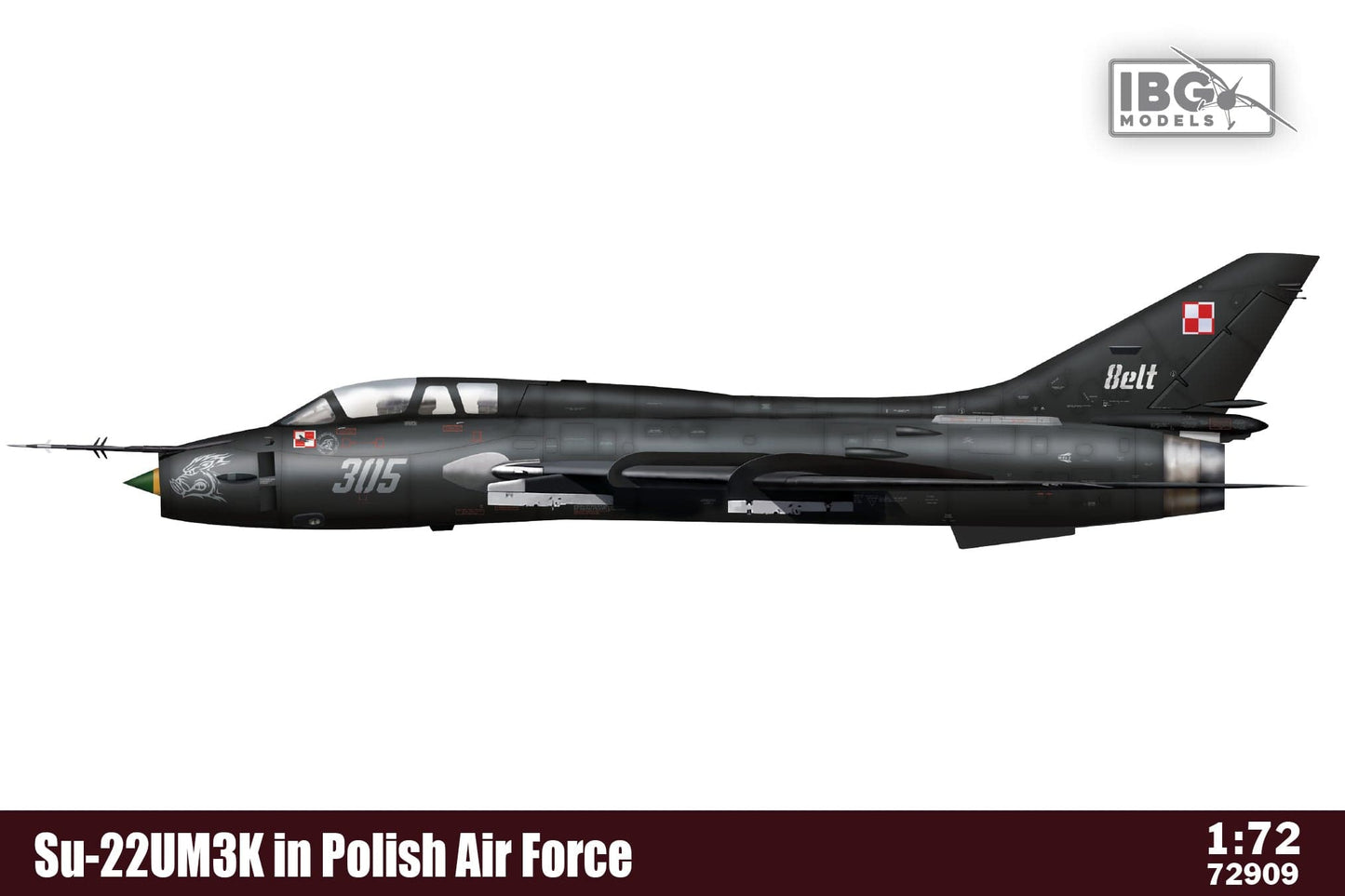


Soviet Union
Sukhoi Su-22UM3K Fitter
| type |
|---|
|
Plastic model kit |

This boxed set contains:
- 1 x Supermarine Spitfire Mk I 1/72 scale fighter aircraft
- 1 x Supermarine Spitfire Mk II 1/72 scale fighter aircraft

Polish Air Force
The Supermarine Spitfire is without doubt one of the most iconic and recognisable aircraft of the Second World War. While its story spans the entirety of the conflict—from the earliest days to the final victory—it was the early variants powered by the Rolls-Royce Merlin engine with a single-stage supercharger that laid the foundations of the modern Royal Air Force, both technologically and symbolically.
The fighter variants Mk I and Mk II formed the backbone of RAF Fighter Command during the critical early years of the war. The Spitfire Mk I became fully operational in 1938–39 and was widely distributed among frontline squadrons by the time of the German invasion of France. Powered by the early Rolls-Royce Merlin II and III engines and armed with eight .303 Browning machine guns, the Mk I offered excellent speed, climb rate, and agility—qualities that quickly earned it a fearsome reputation among both RAF pilots and their German adversaries.
As the Luftwaffe began its sustained aerial campaign against Britain in the summer of 1940, Spitfires Mk I were deployed across southern England to counter the waves of German bombers and their fighter escorts. While the more rugged and numerous Hawker Hurricanes often took on the bombers, Spitfires were frequently tasked with engaging the German Bf 109s in the high-altitude dogfights that became the hallmark of the Battle of Britain. The Spitfire’s tight turning radius, sensitive controls, and superb visibility gave it an edge in one-on-one combat, allowing skilled pilots to outmaneuver many of their opponents.
The Mk II, introduced in late 1940, featured minor but meaningful improvements, including a more powerful Merlin XII engine and a stronger airframe with provisions for a Rotol constant-speed propeller. Though visually nearly identical to its predecessor, the Mk II offered better climb performance and reliability, allowing it to take over frontline duties as production of the Mk I began to slow. Together, these two early marks of the Spitfire became symbols of resistance, courage, and technical excellence—machines that not only helped win the Battle of Britain, but laid the foundation for the RAF’s growing dominance in the skies over Europe.
This boxed set contains:
-
1*Supermarine Spitfire Mk I 1/72 scale fighter aircraft
-
1*Supermarine Spitfire Mk II 1/72 scale fighter aircraft
The Supermarine Spitfire is without doubt one of the most iconic and recognisable aircraft of the Second World War. While its story spans the entirety of the conflict—from the earliest days to the final victory—it was the early variants powered by the Rolls-Royce Merlin engine with a single-stage supercharger that laid the foundations of the modern Royal Air Force, both technologically and symbolically.
The fighter variants Mk I and Mk II formed the backbone of RAF Fighter Command during the critical early years of the war. The Spitfire Mk I became fully operational in 1938–39 and was widely distributed among frontline squadrons by the time of the German invasion of France. Powered by the early Rolls-Royce Merlin II and III engines and armed with eight .303 Browning machine guns, the Mk I offered excellent speed, climb rate, and agility—qualities that quickly earned it a fearsome reputation among both RAF pilots and their German adversaries.
As the Luftwaffe began its sustained aerial campaign against Britain in the summer of 1940, Spitfires Mk I were deployed across southern England to counter the waves of German bombers and their fighter escorts. While the more rugged and numerous Hawker Hurricanes often took on the bombers, Spitfires were frequently tasked with engaging the German Bf 109s in the high-altitude dogfights that became the hallmark of the Battle of Britain. The Spitfire’s tight turning radius, sensitive controls, and superb visibility gave it an edge in one-on-one combat, allowing skilled pilots to outmaneuver many of their opponents.
The Mk II, introduced in late 1940, featured minor but meaningful improvements, including a more powerful Merlin XII engine and a stronger airframe with provisions for a Rotol constant-speed propeller. Though visually nearly identical to its predecessor, the Mk II offered better climb performance and reliability, allowing it to take over frontline duties as production of the Mk I began to slow. Together, these two early marks of the Spitfire became symbols of resistance, courage, and technical excellence—machines that not only helped win the Battle of Britain, but laid the foundation for the RAF’s growing dominance in the skies over Europe.