

United States

United Kingdom
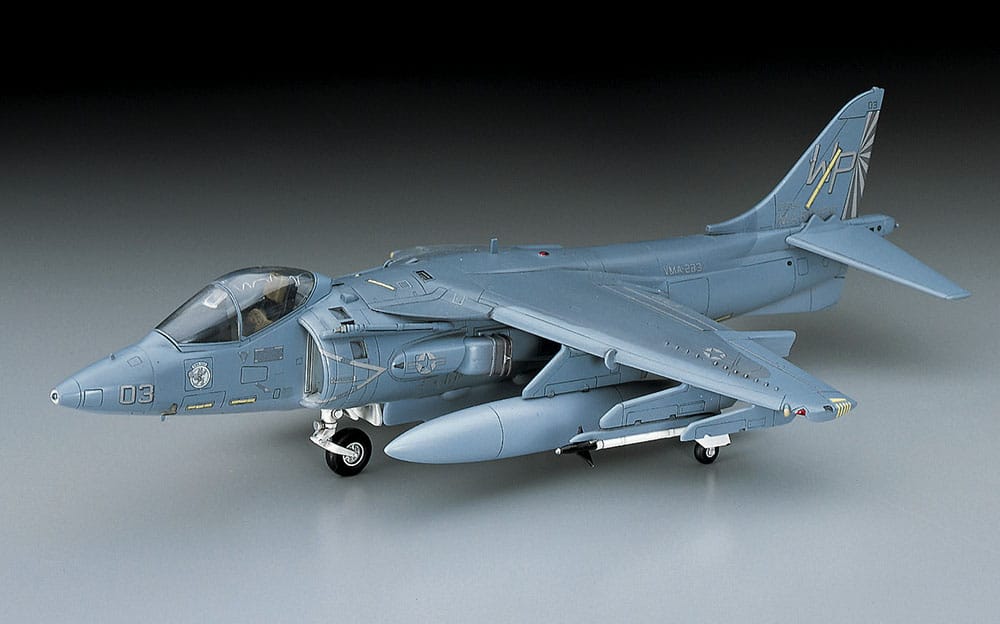
McDonnell Douglas AV-8B Harrier II
| type |
|---|
|
Plastic model kit |


This boxed set contains:
- 1 x McDonnell Douglas AV-8B Harrier II 1/72 scale v/stol attacker aircraft [D Series]


United States Marine Corps Aviation

As the world's first practical V / STOL attack aircraft
Harrier, who appeared in the early 1960s,
The U.S. Marines were featured as a landing support fighter.
It was adopted under the name AV-8A.
However, operational problems due to insufficient payload and cruising range are not easily resolved,
The AV-8A developmental model has long been required.
The AV-8B, which appeared under such circumstances, is in order to meet the tactical requirements of the United States Marine Corps
Significant capacity was improved.
The main wing is enlarged, and the cross section becomes super-critical wing shape,
LERX (front edge extension) was installed at the base of the main wing, which was improved aerodynamically.
In addition, due to the large use of composite materials, the weight is minimized,
In addition, the auxiliary wheels under the wings move from the wing end to the center of the main wing,
Two more hard points under the wing.
On the other hand, avionics have also undergone significant modernization,
The nose is equipped with ARBS (angular speed bomber system) that was put into practical use in the A-4M Skyhawk,
The accuracy of the weapon is greatly improved, and furthermore,
Multi-purpose display and HOTAS method (from the steering stick and throttle)
In addition to the adoption of various systems that can be operated without letting go of hands),
The canopy was enlarged to increase maneuverability with a wide view.
In addition, for improvement of air intake and for pre-exhaust nozzles
Adopting a zero scarf nozzle to increase thrust efficiency,
At the time of VTOL, the newly built retractable front fence and
of the large, conventional removable streki,
LIDS (Lift Improvement Devices)
Ground Reflective Jet Lifting Power is now available effectively.
In addition, the airborne oil receiving device is equipped with a retractable oil receiving probe.
The first real-world unit deployment was against VMA-331 in 1985.
Data AV-8B HARIER II
Crew: one.
Total width: 9.25m
Total length: 14.12m
Height: 3.56m
Engine: Pegasus R.R. F-402-RR-408×1 (thrust 10,795kgx1)
Maximum take-off weight: 14,515kg (at STOL)
Max speed: 1,080km/h
First flight: September 6, 1978 (prototype)
This boxed set contains:
-
1*McDonnell Douglas AV-8B Harrier II 1/72 scale v/stol attacker aircraft [D Series]
As the world's first practical V / STOL attack aircraft
Harrier, who appeared in the early 1960s,
The U.S. Marines were featured as a landing support fighter.
It was adopted under the name AV-8A.
However, operational problems due to insufficient payload and cruising range are not easily resolved,
The AV-8A developmental model has long been required.
The AV-8B, which appeared under such circumstances, is in order to meet the tactical requirements of the United States Marine Corps
Significant capacity was improved.
The main wing is enlarged, and the cross section becomes super-critical wing shape,
LERX (front edge extension) was installed at the base of the main wing, which was improved aerodynamically.
In addition, due to the large use of composite materials, the weight is minimized,
In addition, the auxiliary wheels under the wings move from the wing end to the center of the main wing,
Two more hard points under the wing.
On the other hand, avionics have also undergone significant modernization,
The nose is equipped with ARBS (angular speed bomber system) that was put into practical use in the A-4M Skyhawk,
The accuracy of the weapon is greatly improved, and furthermore,
Multi-purpose display and HOTAS method (from the steering stick and throttle)
In addition to the adoption of various systems that can be operated without letting go of hands),
The canopy was enlarged to increase maneuverability with a wide view.
In addition, for improvement of air intake and for pre-exhaust nozzles
Adopting a zero scarf nozzle to increase thrust efficiency,
At the time of VTOL, the newly built retractable front fence and
of the large, conventional removable streki,
LIDS (Lift Improvement Devices)
Ground Reflective Jet Lifting Power is now available effectively.
In addition, the airborne oil receiving device is equipped with a retractable oil receiving probe.
The first real-world unit deployment was against VMA-331 in 1985.
Data AV-8B HARIER II
Crew: one.
Total width: 9.25m
Total length: 14.12m
Height: 3.56m
Engine: Pegasus R.R. F-402-RR-408×1 (thrust 10,795kgx1)
Maximum take-off weight: 14,515kg (at STOL)
Max speed: 1,080km/h
First flight: September 6, 1978 (prototype)